

AMP is WAC -- 07/17/26
Ape-solutely Tree-mendous Growth

This week was fueled by chocolate. It started with a debate about which of the Hershey miniatures is best. I think Mr. Goodbar is terrible. Concept is awesome, execution is just a cough waiting to happen.
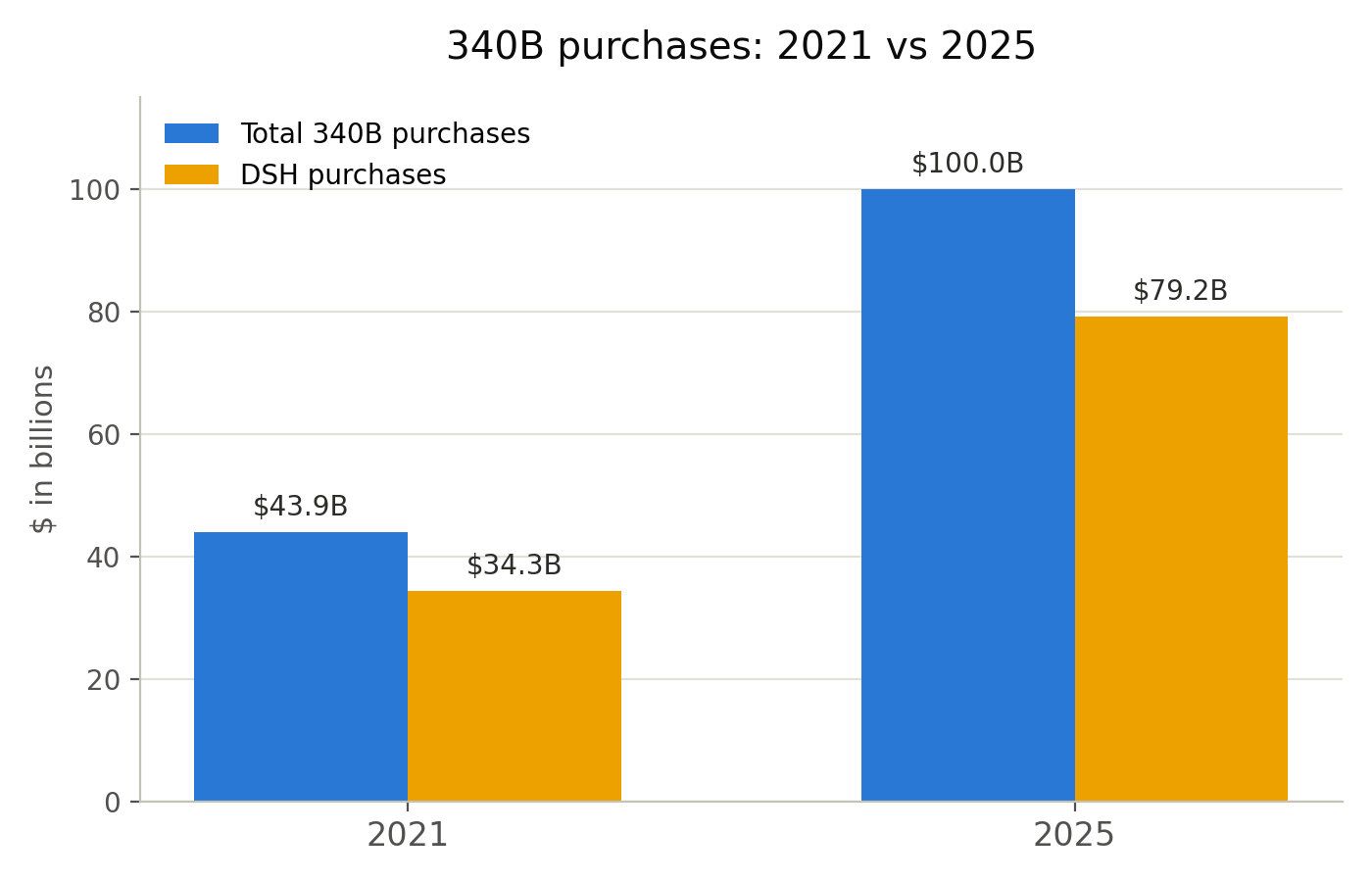
Doubling Down. This week, HRSA published the 2025 340B Covered Entity Purchases report, and the topline is hard to miss. Covered entities bought $100.0 billion in outpatient drugs under the program last year, up from $43.9 billion in 2021. That’s the program more than doubling (up 127.8%) in four years.
Disproportionate share hospitals, the biggest slice of the 340B pie by a wide margin, grew even faster. DSH purchases went from $34.3 billion in 2021 to $79.2 billion in 2025 (up 131.1%), and their share of total program spending crept up a bit, from 78.1% to 79.2%.
I mean, none of this happens in a vacuum. HRSA’s own notes point to the usual suspects: specialty drugs (oncology, immunology, obesity) driving unit costs, care shifting from inpatient to outpatient, and list prices that keep climbing regardless of who’s paying. The 2025 report shows high-cost specialty products, only 38.1% of units, running up 61.9% ($61.9 billion) of total 340B spending. Keytruda alone accounted for $8.9 billion in 2024 340B sales.
Here’s the part that should sit uncomfortably with manufacturers. Every dollar of that growth is a dollar of statutory discount (roughly 340B ceiling price, well below WAC) flowing through covered entities, many of which are hospitals with increasingly loose ties to the “safety net” framing the program was built on. Congress keeps hearing that 340B needs guardrails on eligibility and contract pharmacy arrangements. A program that just doubled in four years, with DSH hospitals capturing an even bigger share of it, is not exactly a persuasive rebuttal.
Up to No Good. On July 9, AJMC published a commentary from National Pharmaceutical Council researchers on where upper payment limit (UPL) implementation actually stands.
As of January 2026, four states have prescription drug affordability boards with UPL authority: Colorado and Maryland have voted to implement, Minnesota and Washington are working through the mechanics, and Virginia and Illinois have debated legislation to join the club.
UPLs cap what specified payers (state employee plans, state-regulated commercial plans) can reimburse pharmacies and providers for a drug. They do not touch acquisition cost, which stays anchored to national pricing and contracts. A pharmacy can be required to buy a drug at one price and get capped on the other end at a lower one. That’s a margin transfer, not pricing reform.
Now layer in the coverage gap. UPLs don’t require plans to cover the capped drug, and there are no guardrails against utilization management. In one payer survey the authors cite, half of respondents expected to increase utilization management on UPL drugs, half expected to raise patient cost sharing on them, and 53% expected cost sharing to rise on the entire therapeutic class. Colorado and Maryland patients currently get more favorable tiering on PDAB-selected drugs than patients in non-UPL states. UPL implementation is the thing most likely to erase that advantage, not protect it.
Add a third layer for pharmacies and providers. With ERISA and self-funded plans sometimes exempt, nobody can reliably predict which transaction falls under a UPL until it’s already happened. That’s real cash flow risk for the 1,000-plus independent pharmacies sitting in these four states.
For manufacturers, the read is familiar: a price control with no access guardrail attached tends to solve the government’s spending problem by creating someone else’s coverage problem. I remain doubtful this ends with patients better off.
Formulary Roulette. Last week, JAMA published a study from Johns Hopkins and AEI researchers using IQVIA’s Formulary Impact Analyzer, tracking 2 million first-time fill attempts for single-source branded drugs from 2018 through 2024. The topline: formulary-based rejections climbed 67.4% over that window, from 24.3% to 40.7% of initial attempts. That’s a trendline.
Of the roughly one in three attempts rejected, only 38.6% eventually got the originally prescribed drug filled within 90 days, another 13% got a therapeutic substitute, and 48.4% (nearly half) got nothing in that class at all.
And the shift matters structurally. Formulary exclusions (no coverage, full stop) stayed relatively flat across most payers. Utilization management (prior auth, step therapy) is what’s doing the heavy lifting, up from 13.3% to 32.4% in commercial and from 15.4% to 41.7% in Medicaid managed care. Payers are making patients work harder to get to yes, and a lot of them give up along the way.
For manufacturers, you can win the rebate war and still lose the patient if the pharmacy counter is where the prescription actually dies. It also hands ammunition to anyone arguing pharmacy benefit management (PBM) utilization management has become the access chokepoint.
NAMBA Style. In one of my more geeky picks… Wakely published a strategy guide this month on the seven to ten calendar days Medicare Advantage Organizations (MAOs) get after CMS drops final Part D benchmark values, the national average monthly bid amount (NAMBA) and base beneficiary premium (BBP), to finalize rebate reallocation. Blink and you’ve missed your bid window.
Quick reminder for those who don’t live in bid season: rebate reallocation lets MAOs adjust premiums, Part B premium buydowns, and rebate-funded supplemental benefits after final benchmarks post, but it does not let them redesign the product. The guardrails are narrow on purpose.
Here’s why 2027 stands out -- direct subsidy volatility. If Direct Subsidy comes in lower than modeled, plans are stuck reallocating rebate dollars away from supplemental benefits or eating margin, all inside a window too short for actuarial and product teams to relitigate strategy from scratch. The fix, per Wakely, is scenario modeling and decision rights locked in before the release, not during it.
Every dollar an MAO pulls back from supplemental benefits or shifts into premium is a dollar that changes the beneficiary’s out-of-pocket calculus, which changes adherence, which changes which formulary tier fights are worth having. Manufacturers negotiating 2027 formulary placement are negotiating against a moving benchmark that plans themselves won’t fully understand until a ten-day window most of the industry doesn’t watch closely.
Why did I find it interesting? Honestly, this is pretty dorky territory and this article made it fairly easy to understand.
D Is for Deficit. Last week, AEI’s James Capretta published an analysis comparing Part D spending projections in the 2023 Medicare trustees report against the 2026 release, and the gap should make anyone who called the Inflation Reduction Act (IRA) a savings a little uncomfortable. Cumulative Part D spending for 2023 to 2032 is now projected at $2.3 trillion, more than $0.6 trillion above the 2023 estimate. 2032 spending alone is projected 48% higher than forecast three years ago.
The IRA was sold as lowering what manufacturers charge. The trouble is that has been outweighed by the shift in cost to the federal government, largely through benefit redesign that capped beneficiary premium growth at 6% annually while pushing more of the actuarial risk onto Part D plans and, ultimately, taxpayers. The Congressional Budget Office (CBO) made the same error in the same direction, raising its Part D baseline by $0.6 trillion in February 2026 versus its January 2025 forecast.
And then there are the demonstrations. Both the Biden PDP premium stabilization demo and the Trump administration’s GLP-1 “Bridge” demonstration (running July 2026 through 2027, $50 beneficiary copay, plans not on the hook) run under Section 402 authority that doesn’t require budget neutrality. Capretta’s read: these aren’t research experiments, they’re benefit liberalizations without an offset, and the IRA’s 2030 premium floor (20% of costs) is already teed up to trigger a 48% premium spike nobody is talking about (or has a plan for).
For manufacturers, this is the tell that “IRA savings” was never really about lowering system costs. It was about who absorbs them. Watch 2029 and 2030 closely. The benefit cliffs Capretta flags are exactly where this story repeats itself.
Reimbursement Fundamentals -- Trip Report: Better Late than Never
Science is cool and one of the areas that I think is so cool right now is the psychedelics. On Monday, the Food and Drug Administration finalized its guidance on psychedelic clinical trials and, in the same breath, announced a September 14 public hearing on their potential therapeutic use.
AND on the same day, HHS and the VA signed a five-year memorandum of understanding to get the VA health system ready to actually deploy these drugs if they clear the FDA. Three separate agencies, one coordinated news cycle.
Keep that “if” in mind. The guidance, titled “Psychedelic Drugs: Considerations for Clinical Investigations,” finalizes a draft the agency circulated back in June 2023 and lays out how sponsors should design trials for psilocybin, LSD, MDMA, and related 5-HT2A agonists. Its most useful contribution is a straight answer to the problem that sank Lykos Therapeutics’ MDMA application in 2024: functional unblinding.
Patients who get an active psychedelic can generally tell, patients who get placebo can generally tell, and both effects contaminate the efficacy signal with expectation bias. The new guidance offers a risk-based framework for handling it, plus updated abuse-potential modeling and a heavier emphasis on durability data.
This problem is finally being taken seriously, which is its own small scandal given how long we’ve had to think about it.
The “why are we only just getting here” is part of what I find so interesting. Before 1970, LSD had already appeared in more than 1,000 scientific papers and been administered to roughly 40,000 people in legitimate research, including studies showing meaningfully higher abstinence rates in alcoholics treated with LSD versus placebo. Then Nixon signed the Controlled Substances Act on October 27, 1970, and psilocybin and LSD landed in Schedule I: high abuse potential, no accepted medical use, full stop. The 1971 UN Convention exported the same freeze globally.
It’s not that nobody tried. It’s that the regulatory door stayed shut for three decades on a substance class that had already produced a real evidence base, and the field is now spending its second act re-proving what its first act had already started to show. Rick Doblin founded MAPS in 1986, specifically in response to MDMA’s emergency scheduling, and spent the better part of four decades pushing the FDA pathway before Lykos (MAPS’ for-profit spinout) got rejected in 2024 on exactly the functional-unblinding grounds this week’s guidance now addresses. Roland Griffiths at Johns Hopkins got the first FDA-approved psilocybin study since the 1970s running around 1999 to 2000, and his 2006 paper is the one everybody credits with restarting the field.
President Trump’s Executive Order 14401, signed in April, directed the FDA to issue Commissioner’s National Priority Vouchers to Breakthrough-designated psychedelic programs, which produced three vouchers on April 24: Compass Pathways for COMP360 (psilocybin, treatment-resistant depression), Usona Institute for psilocybin in major depressive disorder, and Transcend Therapeutics for methylone (PTSD).
Compass is targeting a Q4 2026 NDA, with approval possible by late 2026 or early 2027. Otsuka believed in the thesis enough to acquire Transcend for $1.225 billion. But an FDA approval doesn’t move a Schedule I compound off Schedule I. DEA does that separately, on its own clock, and then there’s the REMS-style supervised administration framework the agency has signaled it wants, dosing that happens in a clinic over hours, under observation.
Meaning we’ve got a few steps here: approval, then rescheduling, then infrastructure, before a single prescription reaches anyone. That’s exactly the gap the HHS-VA MOU is trying to close in advance.
For manufacturers, the takeaway splits two ways. This looks more like a Part B buy-and-bill or bundled-procedure reimbursement problem than a Part D drug benefit, and nobody has settled how a plan pays for “drug plus therapist plus a monitored four-hour session.” Second, the CNPV program is already drawing scrutiny for going to companies willing to make pricing concessions.
I remain skeptical the “end of summer” timeline Commissioner Makary floated back in April survives contact with a rolling NDA and DEA rescheduling. But watching a field go from criminalized to Breakthrough-designated to a $1.225 billion acquisition target inside the same generation is still, genuinely, kind of remarkable. We didn’t lose thirty years because the science was bad. We lost them because the politics got there first.